 Abode Ikoi, Founder of Eucarl
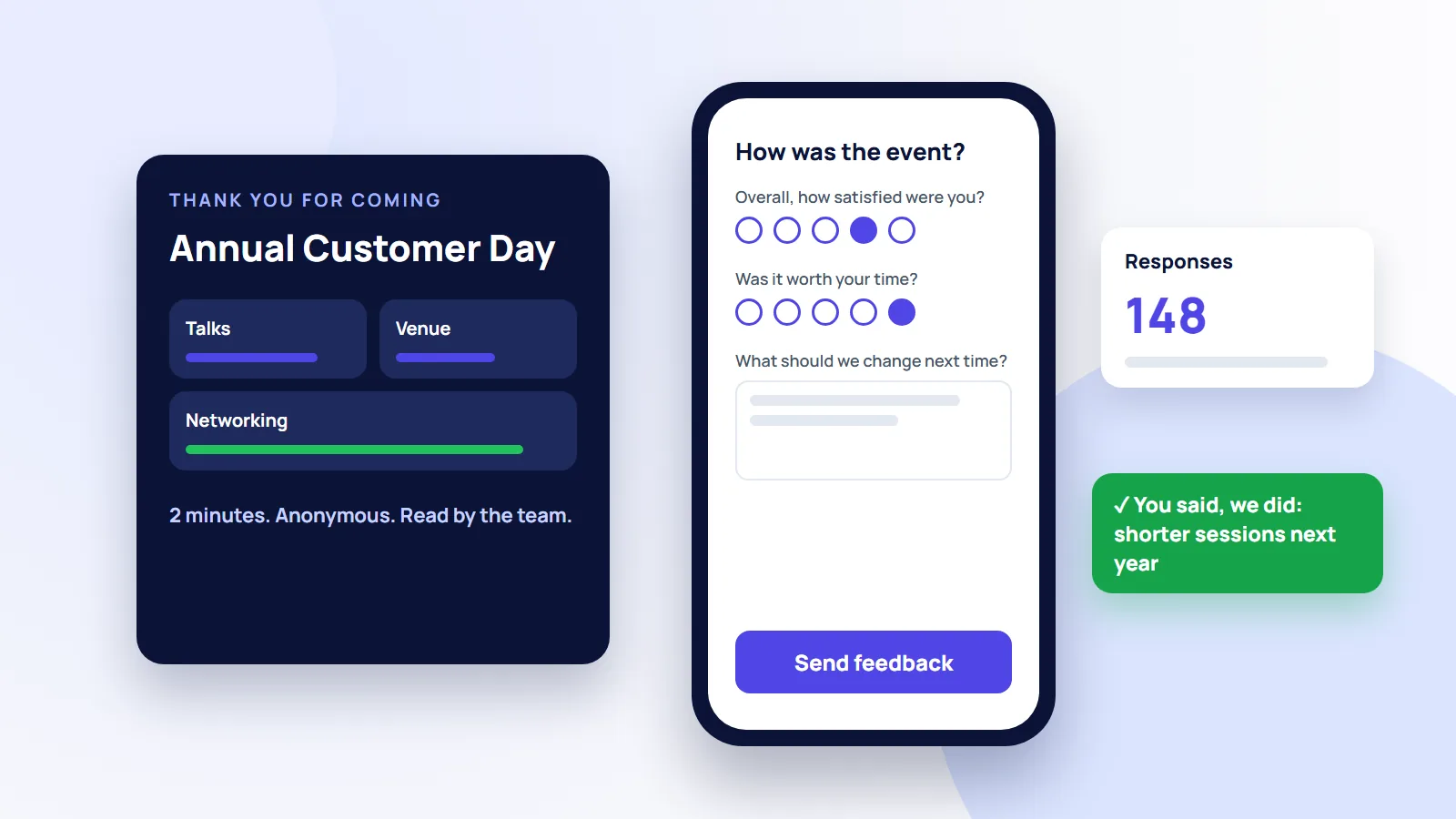
The best post-event survey is short and fast: send 5 to 8 questions within 24 hours of the event ending, start with one overall rating, ask whether it was worth their time, ask what to keep and what to change, and finish with one open question. Below you'll find ready-to-copy question sets for conferences, workshops and training, webinars, customer events and internal team events, plus invitation and reminder emails, guidance on anonymity, and how to turn the answers into changes people can see.
The 8 post-event survey questions that work for almost any event
If you only have time to copy one list, use this one. It covers satisfaction, value, content, logistics and what to do next, in under three minutes.
- Overall, how satisfied were you with [event]? (1 = very dissatisfied, 5 = very satisfied)
- How worthwhile was this event for the time you spent? (Not at all, Somewhat, Very, Extremely)
- Which part was most useful to you? (List the sessions or activities, plus "Other")
- Which part was least useful, or could be cut? (Same list, plus "None")
- How would you rate the venue / platform, timing and organisation? (1 to 5 each, with "Not applicable")
- How likely are you to recommend this event to a colleague or friend? (0 to 10)
- Would you come to the next one? (Yes, Maybe, No)
- What is one thing we should change next time? (Open text)
Two rules make these work. Ask one thing per question: "How were the speakers and the food?" is two questions, and the answer tells you nothing. And give a "Not applicable" option wherever some people could not have experienced the thing you're asking about, such as lunch for online attendees.
When to send a post-event survey (and how long it should be)
| Decision | What to do | Why |
|---|---|---|
| Timing | Within 24 hours of the end; same day is better | Survey providers such as SurveyMonkey and Typeform both advise sending while the experience is fresh, because memory and motivation fade quickly. |
| Multi-day events | A 2-question check at the end of each day, plus the full survey at the end | You can fix day-two problems on day two. |
| Length | 5 to 8 questions, about 2 to 3 minutes | Every extra question costs completions. Put the questions you need most first. |
| Reminders | One reminder 2 to 3 days later, then stop | Catches people who meant to reply; more than that annoys them. |
| Device | Test it on a phone | Many attendees will answer on their way home. |
| Closing date | About a week after the event | Late answers add little and delay your follow-up. |
What counts as a "good" response rate depends on your audience and channel. A useful habit is to track your own rate from event to event and aim to beat it, rather than chasing an industry figure.
Question sets by type of event
Start with the core questions above, then swap in two or three from the set that matches your event.
Conferences and summits
- Which session was the best use of your time? Which would you skip next year?
- How would you rate the balance between talks, workshops and networking time? (Too little networking, About right, Too much)
- Did you meet at least one person you plan to follow up with? (Yes / No)
- How easy was it to find your way around and know what was happening when?
- Which topics or speakers would you like to see next time?
Workshops and training sessions
- How confident are you that you can use what you learned? (1 to 5)
- Was the pace too slow, about right, or too fast?
- Was the level too basic, about right, or too advanced for you?
- What will you do differently in your work because of this session?
- What was unclear or needed more time?
Webinars and online events
- How was the audio and video quality? (1 to 5)
- Was the length about right? (Too short, About right, Too long)
- Did you get your question answered? (Yes, No, I didn't ask one)
- Would you prefer a recording, a live session, or both next time?
Customer events, launches and open days
- What was the main reason you came?
- Did the event change how you see our product or service? (More positive, No change, Less positive)
- Is there anything you expected to see or hear about that we didn't cover?
- Would you like someone from our team to follow up with you? (Optional contact field, kept separate from the rest of the answers)
For ongoing customer feedback beyond one event, see how to collect customer feedback as a small business, and if you want a recommend score you can compare over time, our NPS and CSAT survey template and calculator.
Internal events: all-hands, offsites, town halls and team days
Employees are the audience most likely to tell you what you want to hear, so these surveys must be anonymous and you must say so clearly.
- How useful was this [all-hands / offsite] for understanding our priorities? (1 to 5)
- Did you feel able to ask the questions you wanted to ask? (Yes, Partly, No)
- What question did you have that wasn't answered?
- What should we stop doing at these events?
- What should leadership do differently after today?
If questions go unasked at live events, collect them before and during the session too; see how to run anonymous questions at an all-hands and our meeting feedback form and retrospective templates.
Should your post-event survey be anonymous?
For internal events, yes. For customer and public events, make it anonymous by default and offer an optional, separate box for people who want a reply. A few practical points:
- Say exactly who will see the answers ("Read by the events team; individual answers are not shared with managers").
- Avoid identifying questions in small groups. Asking for department, role and location together can identify someone in a team of 20.
- Don't report on tiny groups. If only three people from one team answered, combine them with others before sharing results.
- Keep contact details separate from the ratings and comments, so a request for follow-up doesn't remove anonymity for the whole response.
For the detail on what makes anonymous feedback genuinely anonymous, read can anonymous feedback be traced?
Copy-paste emails: invitation and reminder
Invitation (send within 24 hours):
Subject: 2 minutes on [event]? We read every answer
Hi [first name],
Thank you for coming to [event] [yesterday/today]. We're planning the next one now and want to know what worked and what didn't.
The survey has [6] questions and takes about two minutes. It's anonymous unless you choose to leave your details.
[Start the survey]
First question: overall, how satisfied were you with [event]? 1 2 3 4 5
We'll share what we heard, and what we're changing, by [date].
[Your name], [role]
Putting the first question in the email lets people start with one tap. Promising to share the results, and doing it, is what gets people to answer your next survey.
Reminder (2 to 3 days later, only to people who haven't answered):
Subject: Last call: what should we change about [event]?
Hi [first name], if you have two minutes, we'd still love your view on [event]. The survey closes on [day]. [Start the survey]
Thank you. [Your name]
At the event itself, put a QR code on the final slide and at the exit, and say out loud before people leave that the survey exists and what you will do with it.
How to analyse the results (in an afternoon)
- Read the scores first. Note the overall satisfaction average, the share who said the event was "very" or "extremely" worthwhile, and your recommend score. Compare with your last event, not with someone else's.
- Look at the extremes. Which session or element got the highest and lowest ratings? Those are your keep and fix lists.
- Group the open comments. Read every comment and tag it with a theme (timing, content level, venue, networking, tech). Count the themes. Ten comments about the same problem matter more than one long complaint.
- Split by audience where you have enough answers, for example first-timers vs regulars, or in-person vs online. A problem can be hidden in the average.
- Pick no more than three changes you will actually make, and one thing you will deliberately keep.
Close the loop: "You said, we did"
The step most organisers skip is telling attendees what happened next. Within two or three weeks, send a short note or post: "You told us the sessions ran too long and there wasn't enough time to talk to people. Next year, sessions are 30 minutes and we've added a networking hour." This shows the survey wasn't a formality, and it is the single best way to raise response rates next time. Our guide to building a you-said-we-did process shows how to make it routine.
Common mistakes
- Sending the survey a week later, when people have moved on.
- Asking 25 questions because "we might need it".
- Leading questions such as "How much did you enjoy our excellent keynote?"
- No "Not applicable" option, which forces people to make up an answer.
- Asking for names on an internal survey and calling it anonymous.
- Collecting answers and never telling anyone what changed.
Want more ready-made forms? Our free feedback templates and kits include survey and feedback forms you can use straight away, and feedback questions that get honest answers explains how wording changes what people tell you.
Frequently asked questions
What should I ask in a post-event survey?
Ask for an overall satisfaction rating, whether the event was worth the time, which parts were most and least useful, how the logistics worked, whether they'd recommend it or come back, and one thing to change. Add two or three questions specific to your event type.
How many questions should a post-event survey have?
Five to eight is enough for most events, which takes about two to three minutes. Put the most important questions first.
When should I send a post-event survey?
Within 24 hours of the event ending, ideally the same day. Send one reminder two to three days later and close the survey after about a week.
Should a post-event survey be anonymous?
For internal events, always. For customer events, make it anonymous by default with an optional, separate field for people who want a follow-up.
How do I get more people to answer?
Keep it short, send it quickly, put the first question in the email, mention it at the end of the event with a QR code, send one reminder, and share what you changed as a result last time.
What do I do with the results?
Review the scores, find the highest and lowest-rated parts, group the comments into themes, choose up to three changes, and tell attendees what you're changing.